Benin: Building on momentum of learning gains

Story highlights
- After concerted effort and success in increasing access to education, the government of Benin, with the support of partners like GPE, has made significant improvement in learning outcomes.
- The improvements are due to structured pedagogy and support in the early grades aligning various parts of the system together with a clear focus on teacher competency and practice in the classroom.
- The country is now capitalizing on the progress and working to make education more inclusive and create impact at scale so that every child receives a quality education.

Benin places a strong emphasis on education, allocating one of the highest portions of its budget to the sector in West and Central Africa.
After concerted effort and success in increasing access to education, the government, with the support of partners like GPE, placed greater focus on the quality of learning, which has led to a significant improvement in learning outcomes.
PASEC assessments show that in 2014, only 10% of grade 2 students were above the minimum proficiency level in reading, but by 2019, that share had jumped to 38%. For math, 34% of grade 2 students were above the minimum proficiency level in 2014 compared to 62% in 2019.
Similar improvements were shown in national learning assessments conducted in 2017 and 2023.

A student does math on a chalkboard in Benin.
Improving learning in primary education
A US$19.4 million GPE grant for 2020 to 2023, managed by the World Bank, helped enhance the quality of teaching and learning in the early years of primary school.
Benin developed new curricula, textbooks (including decodable reading books), student activity books and teacher guides in reading and math for grades 1 and 2.
Teacher guides include structured lesson plans that follow a clear progression throughout the school year. All materials were piloted and tested with revisions made to improve them along the way.

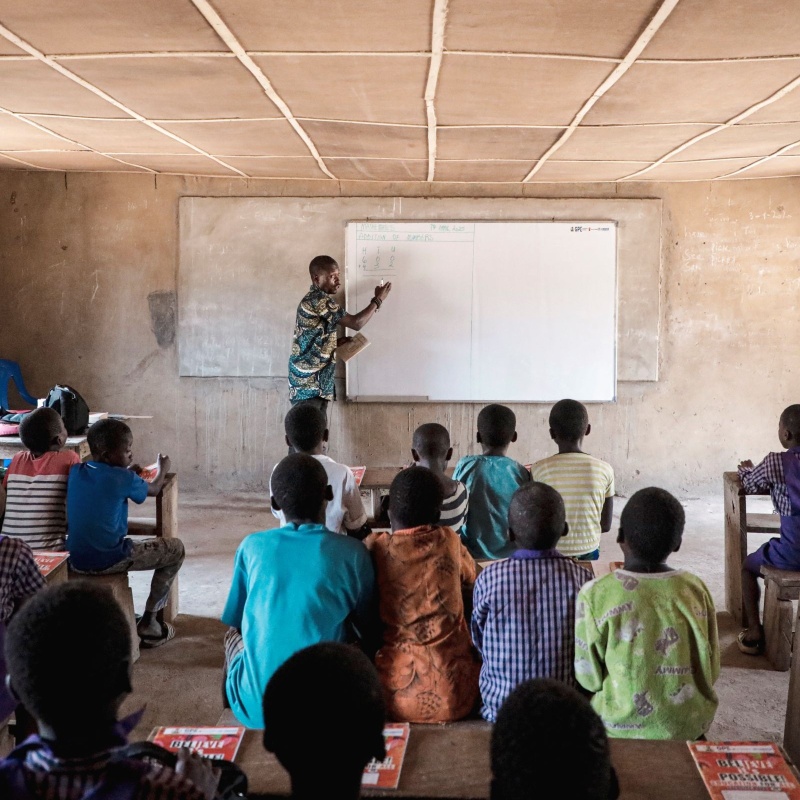
A teacher and her grade 2 students at Sedjeko Primary School, Porto-Novo piloted new learning materials.
Teacher training was implemented nationwide to improve teachers’ understanding of the new curricula, content knowledge and teaching practice skills, including management of time on task and how to use new teaching and learning materials.
There were three cycles of evaluating teachers using the new materials.
In 2021, 66% of the teachers observed were able to use the materials effectively, in 2022, 68%, and in 2023, 80%, showing considerable improvement in pedagogical practices.
The evaluations helped to identify strengths and weaknesses of teachers, which were used to improve in-service teacher training.
“There have always been guides and programs to support teachers, but in this new work that has been done, the types of assessment and the types of skills students learn have been clarified and explained. When the teacher understands them, they know what they are going to talk about in class and how they are going to manage the class.”
To assess the impact of the new curricula and teacher training, the program tracked the percentage of grade 2 students attaining minimum standards in reading and math on national learning assessments.
As more students were learning better, more of them were advancing from one grade to the next: the national average of students’ promotion rate in public primary schools increased from 68% in 2017 to almost 78% in 2023.

A student reads their new French textbook in Benin.
Boosting enthusiasm for reading
With reading fluency on the rise, Benin implemented an activity called "Little Reading Champion Competition" to energize students to read more.
From May to July 2023, disadvantaged municipalities of the Alibori and Borgou regions organized read-aloud competition clubs for students in grades 1 and 2. Over 1,020 public primary schools participated and will continue to hold the competition annually.
In addition to developing reading skills, personal reading practice and building an appetite for reading, the activity raises awareness among students' families about the importance of reading.
Making education more inclusive
With support from GPE, Benin has made the education system more inclusive of marginalized children.
The distribution of uniforms and school supplies to over 300,000 students helped boost enrollment in disadvantaged regions. And awareness campaigns via community radio stations encouraged education, especially for girls.
Benin scaled up promising interventions in the Zou and Collines regions to increase the enrollment of children with disabilities in primary schools.
The education ministry collaborated with the Department for People with Disabilities and the Elderly and the Ministry of Social Affairs and Microfinance to identify children with disabilities, consult with their families about each child’s needs, provide assistive devices such as crutches or hearing aids, pay their school fees and provide school supplies and textbooks, and cover home tutoring costs.
Additionally, teachers and principals of students with hearing loss were trained in sign language and education for the deaf.
Mariam Yekini, a teacher at the Louho integrated school for the deaf in Porto Novo, speaks about one of her students with both motor and hearing disabilities: “Aimé really likes it here at our inclusive school. He is 15 and in grade 1. He is with children ages 6 to 7 who do not have a hearing impairment, and they help him a lot. He is a little older and just learning basic concepts, especially in sign language, but he can communicate with his classmates.”

Children with visual impairment using Braille materials in class in Parakou, Benin.

School kit distribution in Gogounou, Benin.
Benin’s path to achieving results at scale
Benin aims to capitalize on progress and create impact at scale so that every child receives a quality education.
Framed by the presidential priority to further improve learning quality, the government conducted policy dialogue with education stakeholders, including development partners, donors, civil society, teacher representatives and the private sector, to identify challenges to system-wide improvement and transformative solutions to address them.
The dialogue resulted in the creation of Benin’s Partnership Compact, marking the alignment of partners and resources behind the country’s priority: strengthening foundational skills for all girls and boys.
- Ensuring the availability of qualified teachers through improved qualifications and standards, training, accountability mechanisms, recruitment, allocation, support and retainment.
- Strengthening education data production and use.
- Establishing standards for pre-primary education, learning in the early grades, sciences and technology in secondary, and management of schools.
- Reducing economic and social-cultural barriers to education, leveraging community-based interventions for out-of-school children and accelerating girls’ education.
New GPE grants provide funding in support of Benin's reforms. A $25.7 million system transformation grant aims to further improve the quality and inclusiveness of teaching and learning.
A $12.85 million Girls’ Education Accelerator grant aims to increase school enrollment of girls ages 5 to 15; ensure that girls outside the education system have access to quality alternative education; and strengthen adolescents' capacity for participation and decision-making in their learning.
By building on progress, Benin is on a promising path to improving learning for all children. GPE will continue working with the government and partners to mobilize resources critical to helping Benin achieve its education goals.
More country journeys