Cambodia: Sustainable practices for a stronger teaching workforce

Story highlights
- For more than 10 years, Cambodia has worked to improve student learning by strengthening teacher education and building a strong teacher workforce.
- Development partners have worked closely with the government in alignment with national policy and planning, leading to stronger capacity and meaningful reforms.
- By making effective teaching practices a part of the system, the government can sustain this progress under its own budget in the long term.


"Through independent learning, gaining new experiences and sharing them with other teachers, continuous professional development has helped my teaching."
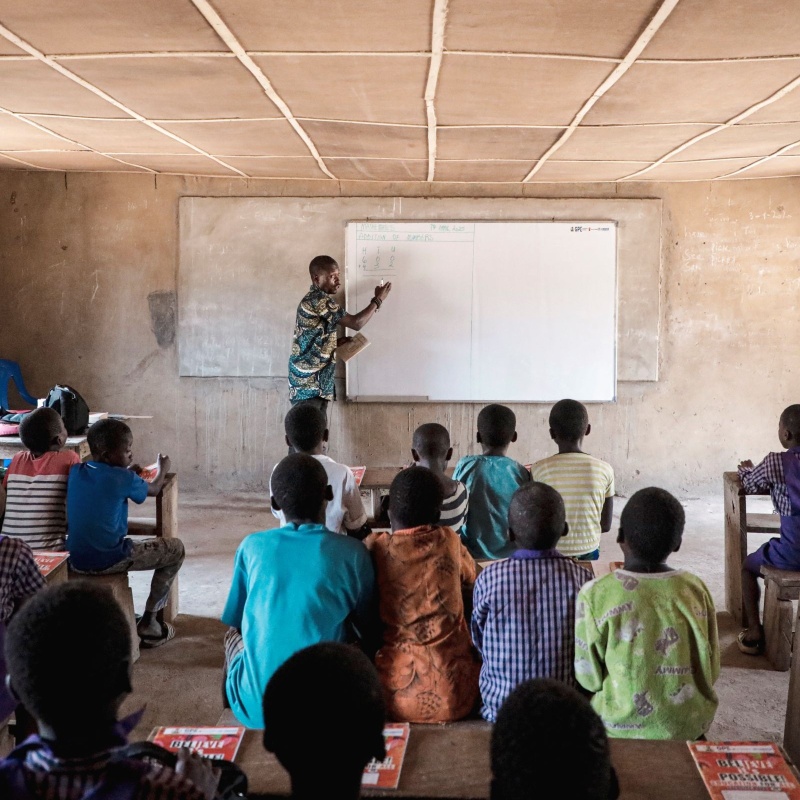
Every morning, Chhay Kimsak steps into her first-grade classroom in Siem Reap with confidence—armed not just with new learning materials, but with a renewed sense of purpose with innovative teaching tools and skills that enhance her classroom teaching.
Just a few years ago, professional development opportunities for teachers in Cambodia were limited.
Today, Chhay is part of a nationwide movement transforming how the country recruits, trains and supports its educators.
Improving teaching = improving learning
Well-prepared, qualified, and motivated teachers are the strongest factor in improving student learning.
For over a decade, Cambodia has prioritized teacher reform to elevate the quality of education. Thanks to government-led collaboration with development partners, national education institutions have been strengthened to support teachers and system-wide practices designed for continuous improvement.
Since the Ministry of Education, Youth and Sport approved the first Teacher Policy and Action Plan in 2013, initiatives such as the Strengthening Teacher Education Programs in Cambodia (STEPCam) have helped improve teaching quality, laying the foundation for lasting improvement in student learning.
STEPCam, supported with a total of US$27 million in GPE grants overs two phases (2018–2022 and 2024–2028), has been one of the largest teacher education programs in Cambodia.
With implementation support from UNESCO, STEPCam has launched the first national system for continuous professional development; scaled up the early-grade teacher training program; renovated teacher training centers; and upgraded the qualifications and competencies of teachers and teacher educators.
The results have been impressive: as of 2022, students taught by STEPCam-trained teachers were outperforming their peers by 91% in early grade reading and math assessments—far surpassing the program’s original target of 54%.
Currently, the second phase of the program is expanding on earlier reforms continuing its system strengthening approach to ensure sustainability and further improve teacher management, leadership, education and development across Cambodia.
Activities implemented under STEPCam have been complemented by education sector capacity development activities funded by GPE and managed by UNICEF.
With strengthened capacity in areas such as planning, budgeting, policy implementation, monitoring and evaluation, the ministry and its partners are accelerating and sustaining reforms.
Enhancing alignment behind government priorities
Cambodia has used GPE funding to support the development of core education strategies in consultation with a wide range of education stakeholders, ensuring that activities funded by partners in the education sector are harmonized and tailored to the country's needs.

"GPE funding has contributed to system transformation. Its support is aligned with Ministry's priorities for the formulation and implementation of two major documents, namely Education Strategic Plan 2024-2028 and the Teacher Policy Action Plan 2024-2030. This ministry-led approach, with broad consultation among stakeholders, ensures that all our efforts are harmonized and meet the specific needs of Cambodia. The support is a sustainable initiative for education development and student learning outcomes for years to come. In this regard, STEPCam directly contributes to our education priorities, including teacher education and development, quality learning and digital transformation, all of which are aligned with our national Pentagonal Strategy for human resource development.”
For the design of STEPCam, the education ministry engaged with technical departments and development partners, including UNESCO, UNICEF, EU, JICA, VVOB, and USAID. The program is directly supporting the review of Cambodia’s Teacher Policy.
Simultaneously, Cambodia's $2.7 million GPE system capacity grant, managed by UNICEF, supported the development of the Education Strategic Plan 2024-2028, which states the ministry’s commitment to implement the Teacher Policy Action Plan.
Both STEPCam and the capacity grant are directly supporting the implementation of the Teacher Policy Action Plan 2024-2030.

“The development of the Teacher Policy Action Plan 2024-2030, supported by the Capacity Development Partnership Fund-III, involved a highly consultative process through establishing a taskforce comprised of key stakeholders including Ministry of Education, Youth and Sport leadership, teacher representatives and development partners. This inclusive and collaborative approach has not only deepened the strategic alignment of partners’ efforts to the plan, but it has also supported unlocking new initiatives, including JICA’s partnership on strengthening the two teacher education colleges and potential support to develop others.”
This government-led, harmonized approach to policy planning and implementation ensures that program activities are embedded within the national education reform agenda and increases the likelihood that they will be sustained and scaled beyond program time frame.
Strengthening institutions to support every teacher
STEPCam has focused on building the capacity of the education ministry to better prepare teachers to enter the classroom and support capacity development throughout their careers.
The program upgraded 11 provincial teacher training centers with modern facilities (including Wi-Fi, computers and libraries)—infrastructure that will benefit around 240 teacher educators and nearly 1,300 primary school teachers annually.

“As a student teacher, I learned theory to apply with students and new teaching methods, including how to use technology, such as Wi-Fi and computer systems. Moreover, I built a good relationship with friends at school and in the community.”
The establishment of a national Continuous Professional Development (CPD) system for teachers is ensuring that educators continue to improve their skills and adapt to new educational needs over time. Previously, teachers had limited opportunities for further training after entering the profession.
As of June 2025, the CPD system has expanded with over 50 accredited offerings and five providers, including courses on inclusive education, ICT skills and formative assessment. Over 8,500 teachers earned CPD credits and are registered in the system.
STEPCam is helping teacher education institutions take the lead in fulfilling the role of CPD providers to ensure that offerings and content are relevant to the Cambodian context.
At the same time, through the national early-grade teacher training and mentoring program, more than 2,600 mentors have provided ongoing professional support to early grade teachers. Over 28,000 mentoring visits have provided support to teachers.
The mentoring component has created a culture of peer support and learning. As teachers learn and improve, they pass on effective practices to other teachers, sustaining the improvements in teaching quality.

“As teachers apply what they learn from continuous professional development, I see that their students are more engaged.”
The institutionalization of improved teacher training methods and a system of professional development and mentoring for teachers ensures that the government can continue these efforts in the long term.
Leveraging technology for equity and resilience
Cambodia’s efforts to build a more resilient education system include digitalization to make learning more accessible and effective.
STEPCam, during phase 1, contributed to Cambodia’s digitalization of education by equipping teacher training centers with technology, such as computers and interactive learning tools, and training staff to maintain and manage these systems.
Over 460 teacher educators and management staff at the teacher training centers were trained through blended in-service training courses on ICT and transformative pedagogy, helping ensure effective use of digital technology to enhance teaching and learning.
STEPCam also developed a repository of teaching materials, which can be updated, providing long-term resources to enhance teaching practices.
This includes the digitization of the early grade math packages and the development 335 videos of math exercises accessible through QR codes in student math books.
To improve education data collection and use:
- The education ministry’s management information system for human resources has been upgraded and made available online for over 130,000 education staff, allowing teachers to check their profiles, enroll in training and track professional development credits.
- A new Student Tracking System helps monitor learning outcomes, dropout rates, gender, disability status, scholarships and attendance, among other indicators—enabling early identification and interventions for students who are falling behind or at risk of dropping out.
In phase 2, STEPCam continues to strengthen support to the country to leverage technology in education, with a new component to invest in the digital transformation of Cambodia’s education system.
The program is supporting the education ministry to develop its first-ever national ICT and AI Competency Framework for Teachers, as well as establish a specialized knowledge hub for educational technology.

“Teachers are at the center of UNESCO’s work in education. We must ensure that teachers are supported to empower generations of young Cambodians to fully realize their potential. By providing teachers with quality initial teacher education and professional development opportunities, we can build a strong teacher workforce ready to meet the evolving needs of today’s world. With the rapid advancement of technology and artificial intelligence, more than ever, teachers have to be equipped with the digital skills and knowledge to shape Cambodia’s future.”
Collaboration that drives change
Cambodia has well-established mechanisms for education sector dialogue and coordination, and the strong collaboration between the ministry and development partners helped secure GPE funding for STEPCam.
The program aligns with national priorities and international best practices, and promising results have led several partners to provide financial support to scale key interventions.
Cambodia’s 2025 Partnership Compact reinforces this collective commitment to quality teaching and learning.
A system built for continuous improvement
Monitoring and evaluation have been core to STEPCam's design. A data-driven approach has ensured that the Cambodian education system can adjust and refine its teaching practices and teacher training efforts over time based on evidence.
By developing evaluation frameworks and feedback mechanisms, the program has created a system of continuous learning and adaptation, which is crucial for long-term sustainability.
With support from GPE and other partners, Cambodia is building a stronger teaching workforce through STEPCam. By embedding effective practices into the education system, the country is paving the way for even greater progress in the long run.
More country journeys