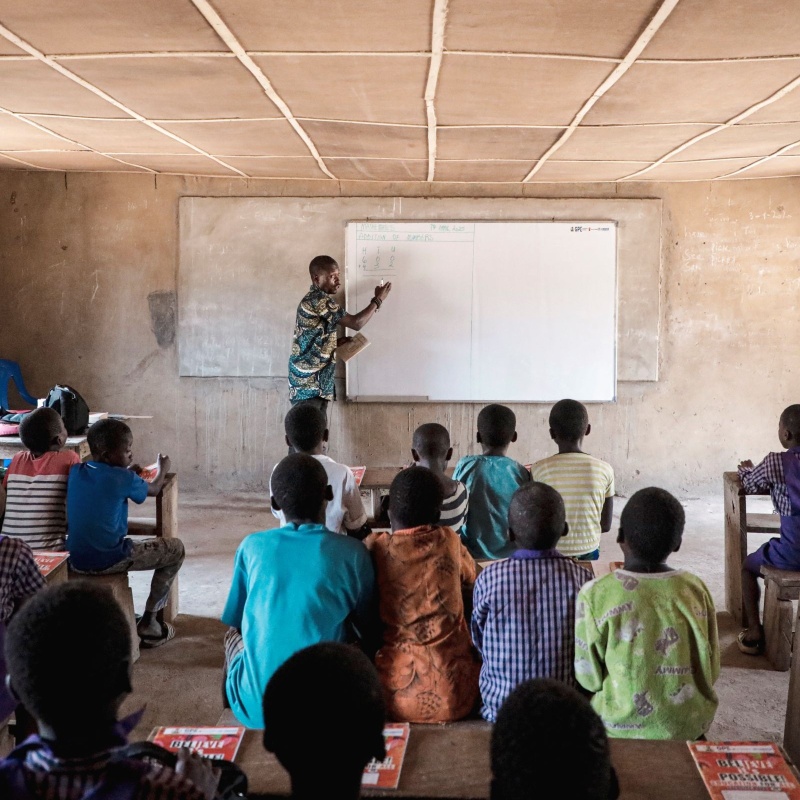
Malawi: Tech boosts literacy and numeracy skills

Story highlights
- Most children in Malawi lack basic literacy and numeracy skills, which leads to students repeating grades or dropping out of school.
- The Ministry of Basic and Secondary Education is rolling out a tablet-enabled learning program in all public primary schools to reinforce teacher instruction in foundational skills.
- The software allows children to learn independently at their own pace, and studies show significant improvement for girls and boys equally.


“[On the tablet] I learn words and phrases and how to find similarities between them. I learn words like ‘hyena’, ‘dog’ and ‘bag’.”
Every day, Lute and her grade 3 classmates pick up solar-powered tablets and begin a 30-minute reading or math lesson. With just a few taps, each child is engaged with content adapted to their individual learning level.
Lute loves to learn, and her favorite subject is Chichewa, one of Malawi’s national languages. She lives in rural area of Dowa District in central Malawi, with her mother, father and two siblings.
At home, Lute helps look after her little sister and shares what she learns in class.
Lute’s school is among the first public primary schools in Malawi to implement Building Education Foundations through Innovation & Technology (BEFIT)—a government-led program supported by GPE to improve foundational learning for children in grades 1-4.
BEFIT scales up a tablet-enabled learning program piloted in Malawi, which saw significant gains in students’ literacy and numeracy skills and prompted a nationwide roll out to serve nearly 4 million students per year.
The tablets, which work fully offline, are programmed with lessons aligned with the national curriculum and supplementary to classroom teaching.
After signing in, Lute and her classmates start each session by working through a diagnostic assessment. The software assesses the child’s level of proficiency and assigns literacy and numeracy content in line with each child’s learning needs.
Child-directed learning is particularly important in classrooms with a high number of students, where teachers are unable to provide one-on-one support.
In Malawi, over 65% of primary schools have classrooms with more than 90 students.
During tablet lessons, a teacher avatar guides students, demonstrating and clearly explaining new material and giving support and encouragement.
For Lute, using the tablet makes learning feel like a game: “We learn addition by moving things into boxes.”
Addressing low learning in Malawi
In Malawi, only 13% of children can read and comprehend a simple text by the age of 10 and even fewer have basic numeracy skills, increasing their chances of repeating grades or dropping out of school.
To make sure children develop the skills they need to progress through school and shape a brighter future for themselves and their communities, the government is focused on improving the quality of foundational teaching and learning.
The tablet program is one intervention helping to achieve this goal, as part of the ministry’s 5-Strand Foundational Education Strategy (5-SaFES).

“We are very hopeful and excited that we can actualize our objectives in quality, equity and access in education using technology as an accelerator. Guided by the government’s foresight of a digital economy driven by relevant skills, we are geared to build a strong human capital foundation for Malawi to become an inclusively wealthy, self-reliant, upper-middle income country by 2063, through innovative partnerships. The BEFIT national scale may look like uncharted territory for many, but this is also an exhibit of a changed mindset that we have embraced to realize the dreams of our children and the future of our beloved nation."
Malawi is scaling up the tablet program nationwide from 2023-2029 with the support of partners including Imagine Worldwide and software developer onebillion.
A GPE Multiplier grant of US$15.2 million, which leveraged an additional $15.2 million in cofinancing from private donors, is funding the following program activities from 2024-2026:
- Equipping schools with the infrastructure to expand the tablet program, such as software, hardware and solar panels, and establishing a network of technical support at the district, zone and school levels, which includes training local technicians in repair and maintenance of tablet equipment
- Training teachers and school leaders in program management, and engaging community members to monitor program implementation and ensure the security of the equipment installed at schools
- Strengthening program monitoring, evaluation and learning systems to inform program adaptations and scaling
- Building capacity and expertise throughout the existing education system during the scale-up phase to ensure smooth transition to full government management of the program.
The government has committed to sustaining the program after the scale-up process is complete. The recurring costs of the program will be close to $3 per child per year and will decrease as Malawi learns and adapts for more efficiency.
Using an environmentally sustainable approach

“The technology is well designed for sustainable impact. We don’t have to depend on grid power—we are using solar energy, introducing it to all public primary schools in Malawi. We are working with partners, innovatively, creating an opportunity for jobs, sustaining communities, and preparing them for other education technologies and fostering innovation, while tackling the monster of high learning poverty.”
Most schools in Malawi lack reliable electricity. Rather than rely on the grid, the tablet program runs on solar power, a renewable energy source.
GPE funding is helping reach an additional 460 schools during the 2024-2025 academic year, benefiting more learners and teachers than the first year. By 2029, all public primary schools in Malawi will have solar power.
Coupled with ICT training and other technical skills developed through the program, Malawi’s education system will be significantly more “innovation ready” to adopt future education technologies, while building a strong education foundation.

Meet Ayisha
“Because of the tablet, I have learned to write and to read.” Ayisha.
Meet Ayisha and see how she uses the tablet at her primary school in her village in central Malawi.
Supporting girls for a brighter future
Malawi has the world’s 8th highest child marriage rate. Keeping girls in school can reduce child marriage and ensure they have more options later.
However, learning outcomes are lower for girls than boys as early as grade 4, and fewer girls complete primary education or transition to secondary.
Strengthening education in Malawi requires targeted support and interventions to remove the barriers that stop girls from continuing their education.
The tablets used in the BEFIT program have been designed to support girls by featuring strong, positive female characters, while the software is unaware of the child’s gender, avoiding biases that girls may encounter in classroom settings and beyond.
The tablet offers a diverse library with female protagonists and inspiring role models, such as Paralympian Zanele Situ.
Content amplifies under-represented voices, such as a series of comics featuring an autistic girl to bring awareness to neurodivergence.
Many of the books were authored by women or developed through co-creation sessions with children.
Teacher training to implement the tablet program also promotes principles of inclusive education.

Students use solar-powered tablets for literacy and numeracy lessons at Senga Model School, Central Region, Malawi.
Promising results from supplementary tablet learning
The efficacy of the tablet’s software has been demonstrated through 9 randomized controlled trials in four countries, including Malawi, showing significant improvements in literacy and numeracy skills for both girls and boys.
In addition, 1.5 times as many children who have used the learning software for 5 months or longer reached “emergent” or “fluent” benchmarks for reading and math compared to their peers who only received standard instruction. This added value is increasing as the software improves over time.
Also exciting to note is that in Malawi, the gender gap in the percentage of learners who were emergent or fluent in math at baseline was no longer statistically significant at the end of the school year.
Thus, in contrast to typical patterns of gender gaps widening during the lower primary grades, researchers observed gender gaps closing after 1 year in the tablet program.
Teachers, students and parents are seeing the benefits of the supplementary tablet learning program.

"The tablets have reduced dropout rates and absenteeism, increased enrollment, and improved the numerical and reading skills of learners."

"When I’m struggling, the person on the tablet explains it to me, and I learn."
Daniyele's mother is pleased with the progress her son has made: “I’m seeing improvements compared to how they were learning in the past. He can read now.”
With millions of young learners like Daniyele, Ayisha and Lute strengthening their reading and math skills, Malawi is paving the way for more children to progress through school and beyond.
*Name has been changed.
More country journeys