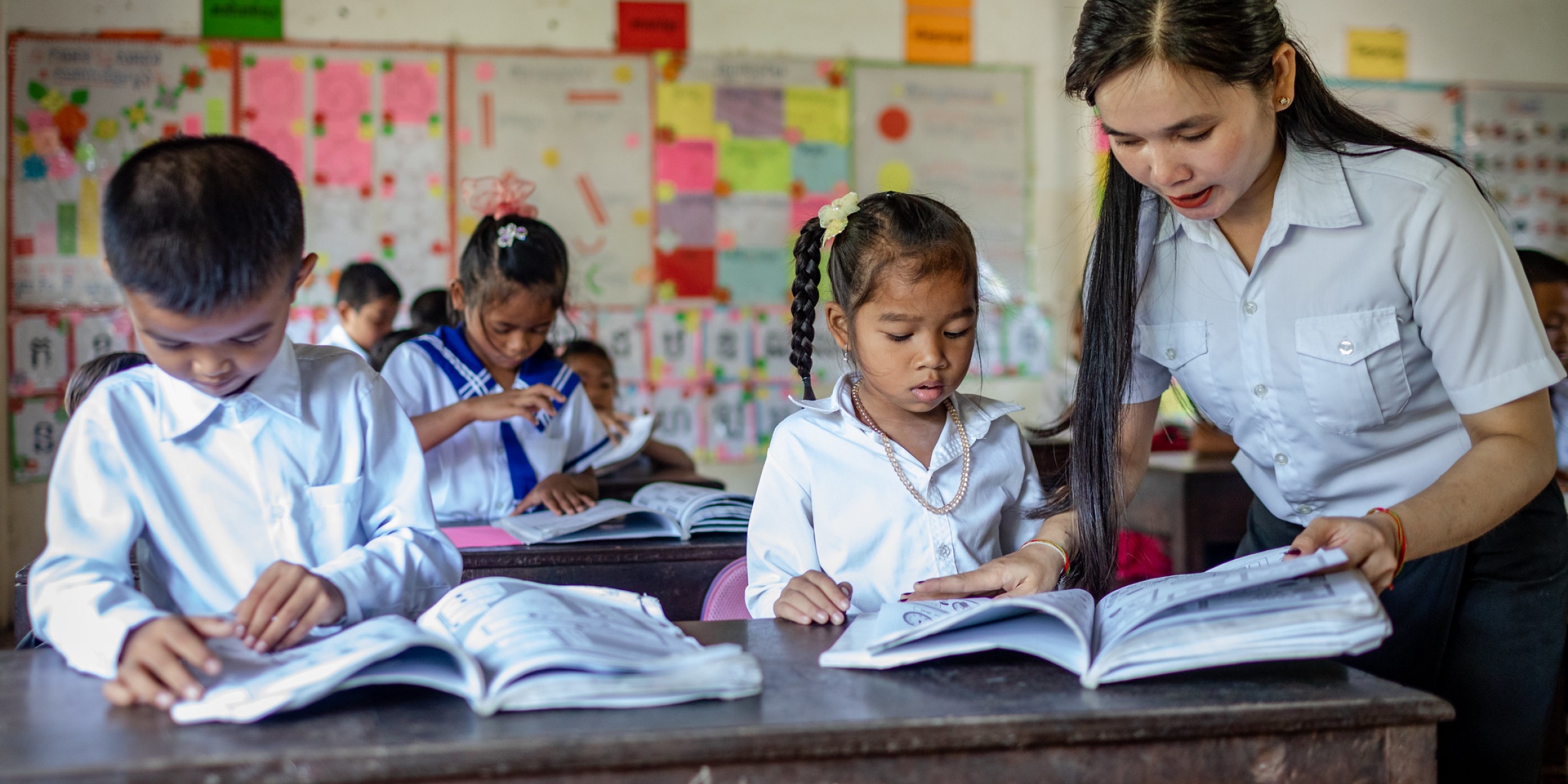
Chhay Kim Hak interacts with her grade one students at Chambak Haer Primary School, Puok District in Siem Reap, Cambodia. Credit: GPE/Roun Ry

Partner since:

Total grant support: US$182,834,755

Grant eligibility:

  • Multiplier
  • System capacity
  • System transformation

Partnership Compact

Priority: Improve student learning outcomes by addressing agreed priorities, namely gender equality, quality learning and quality teaching.

Other key documents

Coordinating agency: UNICEF

GPE Team lead: Talia Miranda

Contact the GPE team lead

Transforming education in Cambodia

Having achieved nearly universal primary education by 2012, Cambodia broadened its education goals to focus on quality in addition to access. Teacher reform, as set out in the Teacher Policy and Action Plan from 2013, has been a key priority of Cambodia's Ministry of education, with various strategies to improve teacher recruitment and performance and pilots over recent years.

The COVID-19 pandemic challenged progress, and evidence of learning loss has fortified Cambodia’s commitment to deliver quality education to all: in 2021, 45% of grade 6 students were not proficient in Khmer language compared with 34% in 2016, and 74% were not proficient in mathematics compared with 49% in 2016.

The government is working with GPE and other partners to improve education in Cambodia by improving student learning outcomes. New early grade learning materials provide structured lesson plans for teachers, improved assessments will help teachers identify students’ learning needs, and teacher training will focus on teaching students at their competency levels.

The government is piloting new remediation measures to support students who fall behind.

Result story

Cambodia: Sustainable practices for a stronger teaching workforce

  • For more than 10 years, Cambodia has worked to improve student learning by strengthening teacher education and building a strong teacher workforce.
  • Development partners have worked closely with the government in alignment with national policy and planning, leading to stronger capacity and meaningful reforms.
  • By making effective teaching practices a part of the system, the government can sustain this progress under its own budget in the long term.

Key data

33%

out-of-school rate for children of lower-secondary school age

50%

of children start learning one year before entering primary school

100%

of primary teachers have the minimum required qualifications

11%

of government expenditure on education

Grants

(data as of October 08, 2025)

 
  • Type: System transformation and Multiplier

    Years: 2024 - 2028

    Allocation: US$25,390,000

    Utilization: US$5,219,360

    Grant agent: UNESCO, UNICEF

  • Type: Multiplier

    Years: 2024 - 2028

    Allocation: US$20,000,000

    Utilization: US$2,839,165

    Grant agent: World Bank

  • Type: System capacity

    Years: 2023 - 2026

    Allocation: US$2,700,000

    Utilization: US$1,040,336

    Grant agent: UNICEF

  • Type: Multiplier

    Years: 2022 - 2028

    Allocation: US$10,000,000

    Utilization: US$4,741,827

    Grant agent: World Bank

Civil society engagement

As part of its investment in civil society advocacy and social accountability efforts, GPE’s Education Out Loud fund is supporting the NGO Education Partnership (NEP) for the 2024-2026 period. This builds on previous support from the Civil Society Education Fund (CSEF).

Learn more

Latest blogs and news

August 12, 2025
Children inspire action on climate issues in Cambodia
Youth across Cambodia are taking notice of climate issues impacting their daily lives. With support from GPE and partners, they’re leading the way with innovative solutions to protect their communities and...